
Stephen Budiansky, the author of the blog liberalcurmudgeon.com, writes in the N.Y. Times today that the local food movement now threatens to devolve into another one of those self-indulgent — and self-defeating — do-gooder dogmas.
.jpg) Arbitrary rules, without any real scientific basis, are repeated as gospel by “locavores,” celebrity chefs and mainstream environmental organizations. Words like “sustainability” and “food-miles” are thrown around without any clear understanding of the larger picture of energy and land use.
Arbitrary rules, without any real scientific basis, are repeated as gospel by “locavores,” celebrity chefs and mainstream environmental organizations. Words like “sustainability” and “food-miles” are thrown around without any clear understanding of the larger picture of energy and land use.
The statistics brandished by local-food advocates to support such doctrinaire assertions are always selective, usually misleading and often bogus. This is particularly the case with respect to the energy costs of transporting food. One popular and oft-repeated statistic is that it takes 36 (sometimes it’s 97) calories of fossil fuel energy to bring one calorie of iceberg lettuce from California to the East Coast. That’s an apples and oranges (or maybe apples and rocks) comparison to begin with, because you can’t eat petroleum or burn iceberg lettuce.
It is also an almost complete misrepresentation of reality, as those numbers reflect the entire energy cost of producing lettuce from seed to dinner table, not just transportation. Studies have shown that whether it’s grown in California or Maine, or whether it’s organic or conventional, about 5,000 calories of energy go into one pound of lettuce. Given how efficient trains and tractor-trailers are, shipping a head of lettuce across the country actually adds next to nothing to the total energy bill.
It takes about a tablespoon of diesel fuel to move one pound of freight 3,000 miles by rail; that works out to about 100 calories of energy. If it goes by truck, it’s about 300 calories, still a negligible amount in the overall picture. (For those checking the calculations at home, these are “large calories,” or kilocalories, the units used for food value.) Overall, transportation accounts for about 14 percent of the total energy consumed by the American food system.
The real energy hog, it turns out, is not industrial agriculture at all, but you and me. Home preparation and storage account for 32 percent of all energy use in our food system, the largest component by far.
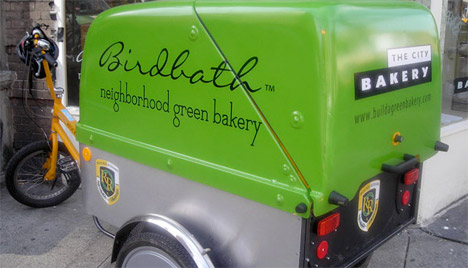 If the goal is to be New York City’s most sustainable bakery, then why not. But sustainable is not the same as sanitary.
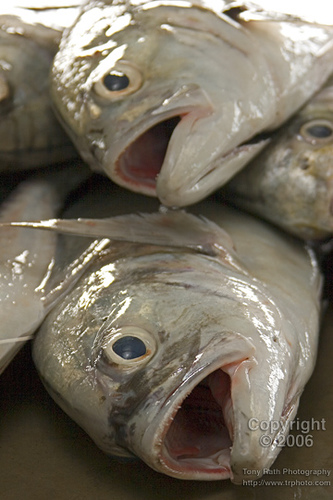 Of course it does, we’re at least 20 hours from any major body of water.
 What’s worse is that sustainably-minded Michael Pollan is stiffing students for $25,000 to come and share his menu planner.
 Marinate farmed salmon fillets (I prefer aquaculture because it is more sustainable) in lime juice, garlic, olive oil and fresh rosemary.
.jpg) “… the advice is being set more firmly in the wider sustainability context and consumers are now being asked to think about the choices they make when they choose which fish to eat.”
“… the advice is being set more firmly in the wider sustainability context and consumers are now being asked to think about the choices they make when they choose which fish to eat.” Whole Foods, defenders of all things natural and sustainable, is featuring beer
 .jpg) Amy, Sorenne and I wandered the grounds earlier this evening to view the overgrowth, eat a few fresh blackberries, let the dogs tear around the yard and for me to once again observe how much I suck at gardening. I’m better at taking care of the seven-month-old.
Amy, Sorenne and I wandered the grounds earlier this evening to view the overgrowth, eat a few fresh blackberries, let the dogs tear around the yard and for me to once again observe how much I suck at gardening. I’m better at taking care of the seven-month-old. I don’t think it’s sustainable to drive 11,000 miles to brag about it
.jpeg) The story has lots of the usual fuzzy stuff about sustainability but mentions nothing about sanitation. In the absence of trays, the silverware better stay on the plate because the accumulated microbiological mess on the cafeteria tables would cross-contaminate any forks, knives and spoons that were placed on the table.
The story has lots of the usual fuzzy stuff about sustainability but mentions nothing about sanitation. In the absence of trays, the silverware better stay on the plate because the accumulated microbiological mess on the cafeteria tables would cross-contaminate any forks, knives and spoons that were placed on the table.