
Ben Chapman

About Ben Chapman

Dr. Ben Chapman is a professor and food safety extension specialist at North Carolina State University. As a teenager, a Saturday afternoon viewing of the classic cable movie, Outbreak, sparked his interest in pathogens and public health. With the goal of less foodborne illness, his group designs, implements, and evaluates food safety strategies, messages, and media from farm-to-fork. Through reality-based research, Chapman investigates behaviors and creates interventions aimed at amateur and professional food handlers, managers, and organizational decision-makers; the gate keepers of safe food. Ben co-hosts a biweekly podcast called Food Safety Talk and tries to further engage folks online through Instagram, Twitter, Facebook, YouTube and, maybe not surprisingly, Pinterest. Follow on Twitter @benjaminchapman.

Mississippi man still recovering from 2011 botulism illness

Mrs. Kalisz, my middle school family studies teacher, scared the crap out of me by telling stories about paralysis and warned of the dangers of botulism by holding up a bulging can of beans. All the food safety and home food preservation stuff I’ve done since then has confirmed that botulism is a nasty affliction.

Of the 20-30 cases of botulism in the U.S. every year, the majority are linked to improper home canning. Deviating from the prescribed steps can create the perfect environment for Clostridium botulinum spore outgrowth, germination and toxin production.  25387440_BG1

According to WMCTV in Memphis, Jay Killen a Horn Lake, Mississippi man has been slowly recovering from botulism for two years. The story reports that Killen consumed the toxin after eating canned beets (although it’s not clear what the source was or if this was confirmed by public health officials).

“One thing he ate changed our entire lives,” said Amanda Killen.

Jay Killen struggles to even eat a spoonful of chocolate pudding, after more than two years in and out of the hospital.

“This is the first I’ve been able to feed myself,” said Jay.

Around Thanksgiving, in 2011, Jay got sick. “I thought I was having a stroke or something,” he explained. So did doctors in the emergency room.

He was unable to move or even breathe; Jay was hooked up to a ventilator and placed in intensive care. By day six, doctors prepared to declare the 40-something former construction worker brain dead.

It may have been a can of beets we had,” said Amanda. “You get to the point where it really doesn’t matter where it came from because it’s not going to change anything,” Amanda explained.

After months tending to her husband, Amanda returned to work, in part, to preserve their health insurance. Jay was unable to even push a nurse call button, so volunteers signed up for weekly two and three hours shifts.

Jay couldn’t speak but regained his ability to blink. Blinking became his means of communication as visitors recited the alphabet.

“I would say at ‘A,’ and I’d say the alphabet, and he’d stop me on the letter I’d write down. And then we’d go to the next letter,” said Amanda.

An interesting side effect from Jay’s illness is that he has fewer wrinkles. Botulism comes from the same toxin used in Botox cosmetic procedures (sort of a weird way to end the story -ben).

In 2012 three folks in Oregon became ill after eating under-processed beets.

CDC says surface water linked to illnesses at 2012 mud run

A couple of weeks ago I agreed to run a Tough Mudder with a couple of hockey buddies. The one I said I’d do is in Charlotte this fall, and I’m reconsidering. CDC’s MMWR (my favorite Thursday read) has details of an outbreak of Campylobacter associated with a 2012 Nevada mud run. According to Zeigler and colleagues, the epidemiological data suggested that the inadvertent swallowing of surface water in one of the obstacles was a risk factor.TMSplash

A case-control study using data provided by patients and healthy persons who also had participated in the race showed a statistically significant association between inadvertent swallowing of muddy surface water during the race and Campylobacter infection (odds ratio = 19.4; p<0.001). Public health agencies and adventure race organizers should consider informing race attendees of the hazards of inadvertent ingestion of surface water.

High-intensity and competitive muddy obstacle adventure course races have surged in popularity across the United States, drawing an estimated 1.5 million participants in 2012 (2). These military-style adventure races attract high numbers of active-duty military personnel, along with young, active, extremely fit civilians. Persons typically are advised of the risks of participating and required to sign a liability waiver. Races are commonly held on farmlands where animal feces increase the risk for zoonotic disease transmission. Primary and emergency care providers, as well as public health professionals, should be aware that obstacle adventure race events could pose a heightened risk for outbreaks from inadvertent ingestion of contaminated water or mud and might consider outreach to educate participants on the health risks from oral contact with contaminated surface water or mud.

Participation in obstacle adventure races is relatively common among men and women of the U.S. military. These events typically are held in rural areas and often include man-made slurry fields (a mixture of soil or clay and water) as race “challenges.” In areas commonly frequented by animals (5), topsoil used in the creation of slurry fields can be contaminated with feces from domestic fowl (6) or ruminants (7) or wild animals. Competitors who run or ride through such areas might unintentionally swallow sufficient numbers of organisms to cause clinical disease. Fewer than 500 Campylobacter organisms are needed to cause illness (1). The race described in this report was held on a cattle ranch, and participants reported seeing cattle and swine on or near the course on race day. Obstacle adventure race planners should consider building slurry field challenges where animal fecal contamination is not likely.

Public health agencies and adventure race organizers should consider informing race attendees of the hazards of inadvertent ingestion of surface water.

Yep.

Asking questions at the farmers’ market

A couple of times a week I take Sam, our three year old, grocery shopping. The kid is all about picking out what the family will be eating while trying to convince me to buy him treats and snacking on the free samples. This weekend I’m going to take him to the farmers’ market with the hopes that North Carolina strawberries will be in (rumors are that the southern part of the state is starting to harvest).

o-AUGUST-OSAGE-COUNTY-TRAILER-facebook

Cheryl Mussatto of of Osage County Online has some decent tips for patrons of farmers’ markets including rinsing produce and keeping meats and eggs cold. These practices are good, but are not unique to markets.

What makes a farmers’ market special is the ability to connect with producers and engage in a dialogue about production practices. Unfortunately Mussatto only suggests conversing about beverages:

There is a key question you need to ask the vendor who is selling milk, juice or cider – “Is it pasteurized?” Pasteurization is a process of heating food to a specific temperature for a certain length of time in order to kill harmful bacteria.

Although it generates sneers from other visitors, I like to ask produce vendors about stuff like water testing and wash water monitoring. When I shop at the grocery store, the corporate folks ask these questions of their suppliers for me. At the market, it’s up to me.


Lots of noro: students sick in Denver; cases on the rise in Missoula

Maybe it’s due to the rise of the Sydney strain, or maybe because of the extra long North American winter season, but there continues to be a lot of norovirus floating around. The Denver Post reports that at least ten high school students have norovirus-like symptoms after attending a Future Business Leaders of America conference in Vail.noro web

About 2,000 students from 165 schools across the state were attending the conference that began Sunday, and stayed in several hotels throughout the Vail area. Authorities said the first students with symptoms apparently were staying at The Sebastian hotel.

The conference concluded Tuesday, and students have returned home. But the state health department expects more cases will be reported due to the close proximity of students to each other on buses and in hotel rooms and the highly contagious nature of stomach viruses.

On Wednesday Larimer County Department of Health and Environment was investigating 10 reported cases of students in the Poudre School District who were suffering similar symptoms after the conference, according to spokeswoman Jane Viste.

In related news KPAX reports that, Missoula health officials are investigating multiple illnesses that appear to be norovirus and it is unclear if they are related.

Disclosing inspection results: Voluntary or mandatory?

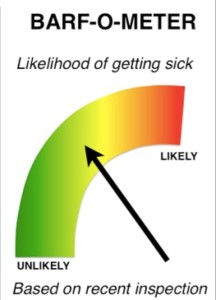
My philosophy on disclosing restaurant inspection information hasn’t wavered much in the past 10 years: Make inspection results public and communicate them meaningfully to help patrons make decisions. There’s a patchwork approach to disclosure throughout the world: happy faces, letter grades, number grades or the not-well-used barf-o-meter.

barf.o.meter_.dec_.12-216x300

Whatever the system is, it’s necessary to pull back the curtain on what happens when inspectors are around. The transparency not only builds trust in the system, but also allows folks to choose businesses based on their own risk tolerance.

According to Australia’s Fraser Coast Chronicle, businesses will be provided with a rating score but will not be required to post it. The hope is that businesses receiving a stellar score will see the marketing advantage and will voluntarily post the ratings – while those not posting due to less-than-ideal ratings will raise their level of attention to get the higher rating.

Branded Scores on Doors, the program’s aim is to encourage food safety across the Fraser Coast.

Businesses will not be forced to display their ratings but the thinking is those with better scores will display to gain customer trust and improved trade.

A report showed those with a lower rating would be made to pay more fees, while the businesses that scored better paid less because fewer inspections were needed.

Joep Dekker from Wild Lotus in Hervey Bay said he would proudly display his score.

He said he was confident of a strong rating because he knew his business had high standards when it came to cleanliness.

“It is something to be proud of, a good score,” he said.

According to the Journal Gazette, Fort Wayne-Allen County (Indiana) health department is taking a different path to disclosing inspections: Moving to a risk-based rating and a corresponding smartphone ap.

Ann Applegate, director of the health department’s Food and Consumer Protection Division, said her department is considering programs from across the country to find a good match for the county.

“We have been looking at several different models of these restaurant grading systems and seeing how we can implement those into what we currently have,” Applegate said.

The new grading scale or points system would place more emphasis on risk-based violations, making it easier for the public to understand the severity of the violation.

[Mindy] Waldron said the department is also in the process of developing an app for smartphones that would allow people to view public documents such as food and beverage inspections.

Not a good week for North Carolina Papa John’s

First a manager at a Charlotte Papa John’s was diagnosed with hepatitis A resulting in hundreds of IgG shots and now a Raleigh-area outlet has been questioned about storing and transporting raw dough unsafely. One situation is a real public health risk, the other elicits some yuck-factor response.29334616_1381404884

According to WRAL’s Monica Laliberte, a local viewer called the TV station to report some less-than-ideal dough handling after not being happy with the restaurant’s response.
When Jim Barnhill saw stacks of pizza dough sitting uncovered outside a Brier Creek Papa John’s, he wondered about the health issues that might raise.

When he saw the same thing again and again, he notified the restaurant. The first time, a manager said, “have it thrown away immediately.” The second time, they told him they’d address the issue.

When it happened a third time, Barnhill brought his photos and video to 5 On Your Side.

He saw dough sitting outside in the rain. “It was sprinkling so the dough was getting hit by the raindrops,” Barnhill said.

Then the exposed dough balls were placed in the back of an employee’s car.

“That’s a problem,” said [health inspector] Thomas Jumalon, upon viewing Barnhill’s video.

“Had this happened during an inspection, if that product had had any rainwater, anything like that, we would advise them to toss it,” he said.

Jumalon had some points of assurance for diners.

He pointed out that pizza dough cooks at 500 degrees for 20 minutes – enough to kill just about anything that could be on it – and that food is exposed to the outdoors whenever you dine outside. He also said transporting food in a personal car is no different than using a company vehicle.

Maybe some physical hazard risks, but not the kind of stuff that leads to foodborne illness.

Norovirus outbreak hits Florida school

Over the past couple of days I drove the family from sunny and somewhat warm Raleigh, NC to the frigid tundra of Southern Ontario. I knew things would be bad when it started snowing as we passed through Maryland – in mid-April.

One of the consequences of a long cold winter is an extended norovirus season (the virus is more stable in cold weather). Norovirus-at-school

Even in Florida.

According to local10, a Broward County, FL school is dealing with a norovirus outbreak – and some folks seem to think drinking from water fountains is a risk factor.

A contagious stomach flu-like virus is making an unusually high number of students at Boulevard Heights Elementary School in Hollywood sick.

“Been a lot of children in our school that are sick,” said student Taylor Frangesh.

“He was nauseated when he came home,” Bianca Hampton said of her son. “He told me he drank from the water fountain, so he was a little nauseated and he had a little fever.”

With the high number of students getting sick, the virus has made its way into some of their homes.

“He got sick, the brother, the sister and me — the whole family,” said Melissa Prado.

Broward County Public Schools released a statement saying the district is working with the health department over gastric concerns that were being experienced by an unusually high number of students. School officials were cleaning and sanitizing classrooms, common areas and the playground.

“They said that the water was causing it and not to drink from the water fountains and if you didn’t bring your own bottled water you still couldn’t drink from the water fountain,” said Frangesh. “They put garbage bags over the water fountains.” 

It was the buns, with Salmonella, in the buffet line

In January 2014 over 30 patrons of Maple Grove MN’s Old Country Buffet fell ill with salmonellosis. Following the illnesses, health authorities investigated the pathogen source and according to the Minneapolis/St. Paul Business Journal are pointing to contaminated dinner rolls as the most probable food. Rolls are a non-traditional foodborne illness source – but a massive norovirus outbreak was linked to Japanese bread earlier this year.old-country-buffet-300x224
The rolls were likely cross-contaminated with Salmonella Enteritidis from raw chicken used in the restaurant (or maybe an asymptomatic food handler or pooled eggs?  that’s what MDH found in their investigation -ben ), Minnesota Department of Health spokesman Doug Schultz said.
“Most outbreaks are preventable: They occur] because a food worker came in ill, or because of cross-contamination. … It’s just a question of what steps should have been taken,” Schultz said. “Contamination doesn’t just happen.”
 
South Carolina-based parent company Ovation Brands (formerly Eagan-based Buffets Inc.) could not be reached for comment.  After the outbreak became known the company said it retrained the entire Maple Grove staff and stepped up food safety inspections.
 
A final report will be issued as soon as next week.

Charlotte Papa John’s manager diagnosed with hepatitis A

Food business owners should worry about hepatitis A. Individuals can shed the virus without showing symptoms and even an infected handwashing superstar will result in lineups outside the business or at the health department while patrons get their post-exposure shots. Even with the costs associated with turnover, I’d probably vaccinate my staff.29334616_1381404884

According to WBTV, a Charlotte, NC Papa John’s manager has been diagnosed with the virus after traveling out of the country resulting in thousands being exposed.

During a press conference on Thursday evening, officials said the employee was a manager at the Papa Johns restaurant who contracted Hep A while traveling out of the country.

The employee was diagnosed on Monday or Tuesday of this week.

“The Mecklenburg County Health Department is working with the State Health Department and our Public Information Office on coordinating messages about what residents who ate food from the restaurant should do,” the email states.

If you ate at the restaurant between March 28 and April 7, officials say you should get a hepatitis vaccination. The vaccine is effective if you were exposed within the last 14 days and could prevent you from getting sick.
 
If you ate food from this location between March 24 and March 27, officials say the vaccination would no longer be effective. In this case, you should be aware of the symptoms and notify your physician if you see them.

There will be a vaccination clinic for people at the Cabarrus County Health Department and Mecklenburg County Health Department on Friday from 4 pm to 8 pm.


Potential outbreak at Muskegon sports bar

Muskegon, MI birthplace of the Detroit Red Wings’ Justin Abdelkader and punk rocker Iggy Pop is also home to what looks like a foodborne illness outbreak. According to Mlive, patrons of Bonicki’s Bistro reported illnesses to owner Norm Spyke as well as the local health authorities.395394_237923292949867_1801694089_n

Officials at Public Health – Muskegon County are asking recent patrons of a Muskegon Township sports bar to fill out a survey to gather data for a foodborne illness investigation.

Jill Montgomery Keast, the health education supervisor at Public Health – Muskegon County, said the agency is in the early stages of determining the type and cause of an outbreak that occurred at Bonicki’s Sports Bistro, 1891 East Apple Ave.
Keast said the department received at least six calls from local customers who fell ill between April 3 and April 6. 
“We were in full compliance as far as I know. They are looking into the matter,” Spyke said.

Bonicki’s achieved compliance with the Michigan Food Law on Jan. 8, according to the latest inspection data available online at www.swordsolutions.com. The records show that sanitarians cited the restaurant for priority violations related to ice and food storage that were eventually corrected.

On the Bonicki’s Sports Bistro Facebook page is a message from the ownership:

Contrary to some news organizations poor reporting skills
WE ARE STILL OPEN!
The Muskegon County Health Department has been here and has checked us on everything, they found nothing wrong with how we store, prepare, cook, or serve our food.
During this time please remember the people that work here, for many of them this is their only job, bad press effects everybody. 
#shoplocal #lovemuskegon

Getting sick from food sucks too.